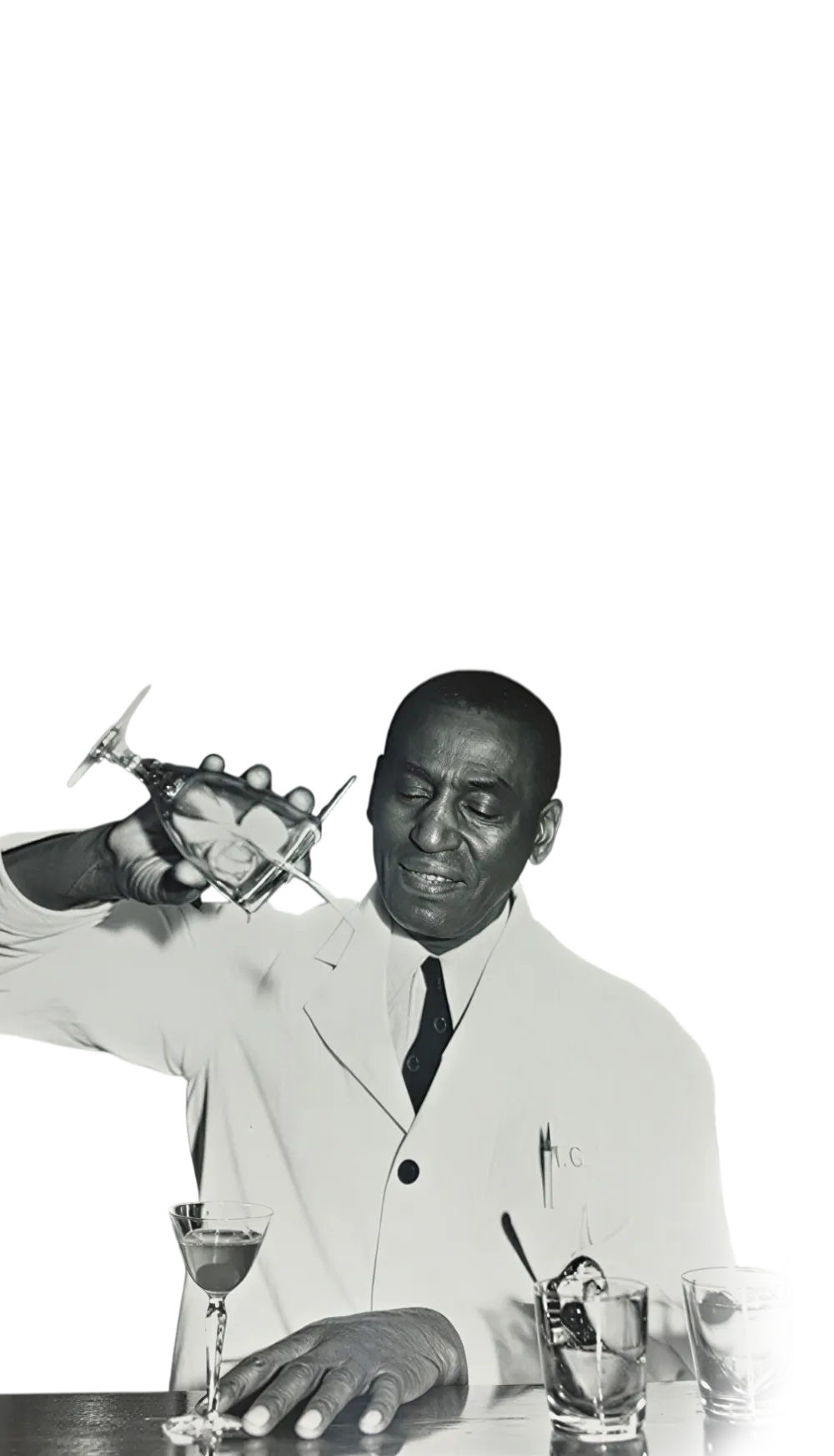
JULIAN
Julian Anderson arrived in Helena in 1886, having traveled a route
that
traced the jagged edges of post-Civil War America. Born in Hamburg, Germany -
where his parents, themselves born into slavery in Virginia, had relocated during the war - he
returned to the American South as a child before making
his way to Washington D.C., then to Denver, where he worked as a bellhop, and then to a bakery
and confectioner's shop in Laramie, Wyoming, which
he later credited with sharpening the precision of hand and instinct that would define his
life's work behind a bar. He arrived at The Montana Club in 1893
and would not leave for sixty years. In that time he became something beyond a bartender -
quietly and without declaration, one of the most
consequential figures in Helena's social history. He served Mark Twain and William Jennings
Bryan, Prince Olaf of Norway and Belgian royalty, and his
favourite among them all: Theodore Roosevelt, of whom Anderson recalled, decades later, that he
was kind and pleasant, a man whose word was
generally law - but who treated Julian well. It is no coincidence that the Rathskeller's poker
room bears the names of two of his most celebrated guests.
Anderson himself never touched a drop of what he made. He received a standing ovation from the
club on his 45th, 50th, 55th, and 60th anniversaries of
service; celebrated his 100th birthday with a punch bowl brimming with 100 silver dollars; and
died in 1962, at the age of 102, having outlasted virtually
everyone and everything the bar had ever witnessed.
In 1919, with Prohibition already sweeping Montana and the golden age
of American bartending drawing to a close, Julian Anderson published Julian's
Recipes - a slim volume of barely twenty pages and roughly sixty drinks, subtitled, with quiet
elegance, In Remembrance of Olden Times. It was only the
second cocktail book ever written by a Black bartender in America, following Tom Bullock's The
Ideal Bartender by just two years, and may well have
been the last cocktail manual published by any American bartender before national Prohibition
took effect. The book is a window into what the finest bars - even in frontier Montana - could
offer their guests in the years before the country lost its drinking memory: the Sherry Cobbler,
the Sazerac, the
Absinthe Frappé, the Pousse Café, one of the earliest printed Daiquiri recipes (listed simply as
"Dai-qui-ri"), and the house drink of The Montana Club
itself - a sweet Martini built on Old Tom gin and vermouth, born in the same decade as the club.
But Anderson's true signature, the drink that made his
reputation travel from Havana to Toronto and San Francisco to Boston, was the Mint Julep. The
mint came from his own backyard garden, grown from
cuttings carried all the way from his childhood home in Virginia - described by one Helena
journalist as "the mother of all mint in Helena." The recipe was
bourbon joined by brandy and a measure of Jamaican rum, sweetened with four cubes of sugar,
crowned with mint, pineapple, orange, cherry, and
powdered sugar. After Anderson's death, The Montana Club continued to serve the Julep in his
honour during a dedicated Mint Julep Month each year.
When the club called him "the master of mixers," they were not being generous. They were stating
something sixty years of service had made impossible
to dispute